Trying to balance school research with a realistic commute can make Naperville feel bigger than it looks on a map. If you are narrowing down where to live, you are probably weighing feeder patterns, train access, drive times, and how much you want daily errands or weekend plans close to home. This guide breaks down how Naperville neighborhoods compare for schools and commute, so you can sort your options in a practical way and move forward with more confidence. Let’s dive in.
Start With Schools First
In Naperville, one of the biggest early decisions is which public school system you are researching. Most buyers will be comparing Naperville Community Unit School District 203 and Indian Prairie School District 204, and that matters because neighborhood names do not always tell you the full school story.
District 203 serves more than 16,000 students, while District 204 serves roughly 26,000 students across parts of Naperville, Aurora, Bolingbrook, and Plainfield. Both districts also note that boundary maps are reference tools, not parcel-by-parcel legal proof, so address-level confirmation is the safest step before you make a housing decision.
District 203 Basics
Within District 203, the high school split is fairly simple at a high level. Homes north of the thick dashed line attend Naperville North High School, while homes south of that line attend Naperville Central High School.
That said, you still want to verify the exact address. If you are shopping in central, north, or northwest Naperville, District 203 is often the first school map to check.
District 204 Basics
In District 204, the subdivision list is often the most useful planning tool. That is especially helpful if you are trying to match a home search to a specific feeder path rather than relying on a general neighborhood label.
Several examples stand out for buyers comparing south and southwest Naperville. White Eagle feeds to Still Middle and then splits to Metea Valley or Waubonsie Valley, Brookdale feeds to Brookdale Elementary, Hill Middle, and Metea Valley, Ashbury feeds Patterson, Gregory, and Neuqua Valley, and Kendall feeds Spring Brook and Neuqua Valley.
Compare Naperville By Area
A practical way to compare Naperville neighborhoods is to follow this order: school feeder priority first, commute mode second, amenities third. That approach helps you stay focused on the factors that are hardest to change after you buy.
Downtown And Central Naperville
Downtown and central Naperville are usually strong starting points if you want easier access to the Naperville station and the downtown core. This area is also commonly part of a District 203 school search, although exact school assignment depends on the specific address.
From a lifestyle standpoint, this is the strongest fit for buyers who want pedestrian-friendly surroundings. The City of Naperville describes downtown as walkable, with hundreds of stores and dining options, and highlights the Riverwalk, library, Naper Settlement, Centennial Beach, and other civic amenities nearby.
Best Fit For Downtown Buyers
This area often works well if you want:
- Shorter access to the Naperville Metra station
- Frequent use of downtown shops and restaurants
- Riverwalk proximity
- A more walkable daily routine
The tradeoff is that if your top priority is quick access to I-88 or Route 59, another part of Naperville may fit better.
North And Northwest Naperville
North and northwest Naperville are usually checked against the District 203 map first. These areas tend to appeal to buyers who want a more suburban commute pattern and easier access toward I-88.
Compared with downtown, the lifestyle here is generally less centered on the core and more focused on residential convenience. If your work pattern pulls you toward western suburban office areas, this location can make the day-to-day routine simpler.
Best Fit For North And Northwest
You may want to focus here if you are looking for:
- Easier I-88 access
- A less downtown-centered setting
- A school search that often starts with District 203
- A suburban commute pattern over walkable core access
White Eagle And Southeast Naperville
White Eagle stands out because it gives buyers a clearly defined District 204 feeder path to start with. White Eagle Elementary feeds to Still Middle, then to either Metea Valley or Waubonsie Valley depending on the assignment.
For commuting, this area offers strong Route 59 access and a balanced profile for buyers who may be thinking about both city and suburban travel patterns. It is a good example of a neighborhood where school clarity and commuter practicality often meet.
Best Fit For White Eagle
White Eagle may be worth a closer look if you want:
- A clearly identified District 204 feeder path
- Convenient access to Route 59
- South Naperville convenience
- A balance between school planning and commute flexibility
Brookdale And Southwest Naperville
Brookdale is another District 204 area that gives buyers a straightforward feeder pattern. Homes here feed to Brookdale Elementary, Hill Middle School, and Metea Valley High School.
On the commute side, Brookdale has strong access to both I-88 and Route 59. That makes it a practical middle-ground option if you want commuter convenience without giving downtown proximity top billing.
Best Fit For Brookdale
Brookdale often makes sense if you want:
- A defined elementary-to-high-school feeder chain
- Strong access to I-88 and Route 59
- A conventional suburban feel
- A middle-ground location for different commute types
Ashbury, Kendall, And South Naperville
If your school search is centered on Neuqua Valley High School, Ashbury, Kendall, and nearby south Naperville areas deserve close attention. Ashbury feeds to Patterson, Gregory, and Neuqua Valley, while Kendall feeds to Spring Brook and Neuqua Valley.
These areas are generally more residential and less walkable to the downtown core. For many buyers, that tradeoff is worth it when feeder clarity and south-side convenience matter more than being near downtown on foot.
Best Fit For South Naperville
South Naperville may be the better match if you want:
- Neuqua Valley as a school priority
- Clearer subdivision-based feeder planning
- A more residential setting
- Retail and restaurant convenience on the south side
The City of Naperville describes the southern part of the city as a thriving retail and restaurant district. That can be appealing if your day-to-day life is more car-oriented and you want errands, dining, and services close to home.
How Commute Patterns Really Compare
For many Naperville buyers, the biggest commute question is not just “How long is the train?” but “How easy is it to get to the train?” That distinction matters more than people expect.
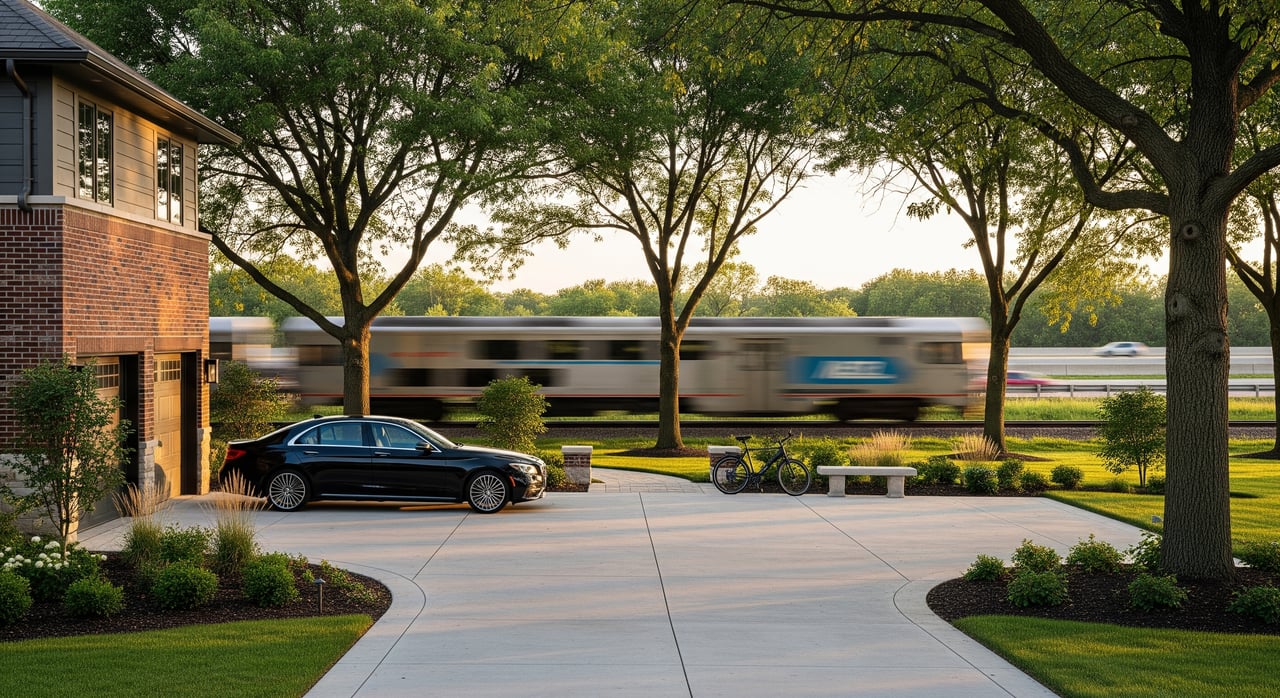
For downtown Chicago, the BNSF Line is the key benchmark. Metra describes it as a frequent, high-speed express corridor, and both Naperville and Route 59 are major outlying weekday boarding stations.
Naperville station has 1,652 parking spaces, while Route 59 has 4,424. In real life, that means platform access and station convenience can shape your daily experience just as much as in-seat travel time.
Loop Commute Reality Check
A timetable example on the BNSF corridor shows a Chicago Union Station to Naperville run of 54 minutes. For most buyers, it is smart to think about a Loop commute as roughly an hour once station access and last-mile travel are added.
Traffic and train patterns vary, so neighborhood commute comparisons should be treated as directional guidance rather than exact daily timing. If your schedule is tight, the best test is often a practice run from the areas you are considering.
I-88 And Suburban Office Access
If you work in western suburban job centers, proximity to I-88, Route 59, or the Naperville station corridor can be especially practical. Metra notes that the BNSF Line serves the Illinois Technology and Research Corridor along I-88 in southern DuPage County.
That is one reason north, northwest, Brookdale, and some Route 59-oriented areas often show up high on the list for buyers splitting time between the Loop and suburban office parks.
The Main Tradeoff To Watch
In Naperville, one of the most common tradeoffs is central walkability versus easier I-88 and Route 59 access. Downtown and central areas can offer stronger access to the city core, Riverwalk, and pedestrian-friendly amenities, while other parts of town may make driving or station access easier.
If you also need a specific feeder chain, that requirement should usually outweigh a broad neighborhood label. In many cases, the smartest move is to identify your must-have school path first, then compare commute patterns within the areas that match it.
A Simple Way To Narrow Your Search
If you are feeling stuck, use this three-step filter:
- Identify whether District 203 or District 204 is your starting point.
- Confirm the feeder path or address-level assignment before falling in love with a home.
- Compare commute mode and amenities only after school fit is clear.
This process keeps the search grounded in facts instead of assumptions. It also helps you avoid one of the most common frustrations in Naperville home shopping, which is realizing late in the process that a favorite home does not line up with your school or commute goals.
Naperville has strong options in several directions, but the right fit depends on how you rank your priorities. If you want help comparing neighborhoods, school-boundary research, and commute tradeoffs in a way that fits your move, Timothy Good is here to help you sort through the details with a local, practical approach.
FAQs
How do school districts work in Naperville neighborhoods?
- Naperville buyers usually research two public school systems: District 203 and District 204. Because both districts say boundary maps are reference tools, the safest step is to verify the exact address before making a decision.
Which Naperville area is best for a Chicago train commute?
- Downtown and central Naperville are often the best fit for short access to the Naperville station, while some buyers also look at areas with practical access to the Route 59 station depending on parking, drive pattern, and daily routine.
Which Naperville neighborhoods are tied to Neuqua Valley High School?
- Ashbury and Kendall are two of the clearest examples in south Naperville. Ashbury feeds to Patterson, Gregory, and Neuqua Valley, while Kendall feeds to Spring Brook and Neuqua Valley.
What should buyers know about White Eagle schools in Naperville?
- White Eagle feeds to White Eagle Elementary and Still Middle, then splits to either Metea Valley or Waubonsie Valley. Because of that split, buyers should confirm the specific assignment for any address they are considering.
Is downtown Naperville more walkable than south Naperville?
- Yes, based on city descriptions, downtown Naperville is the strongest area for walkability, Riverwalk access, shopping, dining, and civic amenities, while south Naperville is more associated with retail, restaurants, and car-oriented convenience.
How should buyers compare Naperville neighborhoods for schools and commute?
- A practical approach is to start with school feeder priority, then compare commute mode, and then look at amenities. In Naperville, that usually leads to a clearer decision than starting with neighborhood name alone.